Pages

Thursday, February 9, 2012

::In My Mother's Kitchen: Thoughts::


I have been thinking a lot about food, because I am teaching a class on food. I like to eat, I like to experiment with ingredients in my kitchen. But when I approach food as the raw material for my scholarly and creative reflections and productions, I am primarily interested in these things: food and its relationship to concepts of power, food as a site of power, food as a site of resistance, food as a site that exists as an intersection of social processes like labor, commodification and consumption. Because I am interested in the labor that happens around food production, I am also interested in the valence of the kitchen-space. Kitchen the space within which most domestic food production happens. Kitchen the space which has, for so many centuries of human history, has been seen as the space where women belong. I can flip the equation around, and also say, because I am interested in gender, I am interested in the history and politics of the kitchen. I have been trying to find poems and memoir-pieces on kitchen. And this is one of the first things that came up when I did a Google search with the keywords In My Mother's Kitchen.

IN MY MOTHER'S KITCHEN

Fragrance of fresh tortillas and corn stew

Fills my mother's kitchen

Sparsely furnished

Crowded with warmth


Soot-grayed walls, secretive and blank

She moves gently in and out of light

Like a dream just out of reach


The morning light gives her a halo

That plays upon her crown of dark hair

Strong brown hands caress soft mounds of dough

She gazes out into the warming day

Past sagebrush hills, out towards the foot of Black Mesa

How far would she let the goats wander today

Before it rains


Childhood dreams and warmth

Tight in my throat, tears in my eyes

The radio softly tuned to a local AM station

News of ceremonies and chapter meetings

And funerals

Flows into the peaceful kitchen

Lines upon her face, features carved of hard times

Lines around her eyes, creases of happy times

Bittersweet tears and ringing silvery laughter

I ache in my heart


My mother's gentle movements light up dark corners

Her gentle smiles recall childhood dreams still so alive

My mother moves in and out of light

Like clouds on days of promising rain

—Shonto Begay


And here is Begay's website: http://shontogallery.com/wp/


What struck me about this poem is the way the poet reveals the little details of the mother's kitchen. There are so many images in this poem, much like the classic confessional/memory poem tradition of American poetry. But, all those image-work have been mobilized towards a specific impulse : to construct the mother's kitchen as an abode of peace, and the mother as a figure who embodies all that is "gentle" in life. Given Begay's personal and creative history, I am seeing in this poem a well-known trend: constructing the kitchen and the mother that provide refuge against the outside world : the world of funerals, tears and chapter meetings. In other words, the colonizing world which is only capable of generating trauma. But then, the mother in this poem is hardly a "real" figure : she "moves in and out of light", she is like a "dream that is out of reach." Yep, she becomes the classic national allegory. The allegory of the indigenous "American" nation that hasn't been born, that probably will never be born, and therefore, like the mother of this poem will always be a little elusive, its dream-like quality providing solace during moments of stressful contacts with the "mainstream" world.


But this is not just all. I am also thinking about how this elusive mother-figure keeps appearing in male poetry throughout the world. And not just the mother figure, the figure of the allegorized woman, Like Jibanananda Das's classic imageries of "kishorir chal dhoya haat" ( the young girl's rice-washed hands). In spite of their huge geographic and cultural difference, what is common in Begay and Das's kind of metaphor-making is that, it transforms women's actual labor into romanticized allegories, symbolizing some kind of inaccessible, elusive antithesis to the trauma of the outside world. So, when I read poems like this, I cannot help asking: where is the actual labor of the mother within the space of the kitchen? How does the mother-figure's frustrations and hysteria get reproduced within the kitchen space? How does the kitchen become the space where women's trauma (as against the "outside" world and its identification as the space for male trauma) gets constituted, articulated, expressed? And last but not the least, how does the mother herself see this kitchen? Does this ever become the space for expressing her creativity? What I am seeing as I am reading these lines I just wrote, what are the questions that we need to ask in order to de-naturalize the idea that kitchen is the essential space where women find belonging, and somehow, that's inherent in the very constitution of women. Unfortunately, in spite of the beauty of his images, that's what Begay's poem ends up doing.


As I am struggling through these questions, I find myself writing some poems which try to answer these questions. So far I have written six such poems. All of them are pretty short. But I am enjoying writing them. And along with finishing the first draft of the dissertation and teaching, that's what I have been up to.

Wednesday, February 8, 2012

;; It's Already February;;

Yesterday I finished the first draft of the Introduction of my dissertation, and today my dissertation group read it. So, now I have the dissertation in FULL. It is not perfect, it is not good, but it exists. That is one step ahead from the time when I wrote my New Year Resolution post. Also, compared to what I did last semester, I am doing FAR better. So far I have written five poems. Again, not good. But still, beginnings. This is already four more than what I accomplished last semester. I have cooked almost every other day. I did eat at my friend's couple of times, but that was more in the spirit of celebration. I am not using her cooking skills and hospitality as a crutch anymore. There have been days when I have experimented with recipes. There have been days when I have just rehashed the old recipes. Sometimes I have made some easy and quick comfort food-- like tonight. I am cooking nothing more than a tomato dal and rice. But still, even the attempt to cook that really simple meal, makes me feel better about myself. In terms of my teaching, I have learnt a LOT. There have been challenges. And it is not that I didn't expect them. But just having my own class to teach, takes off so much pressure. Besides, I am really interested in the materials I am teaching and I am learning to think in a way that is different, yet related to my usual dissertation methodologies. I haven't been able to blog at all, and I am hoping to change that pretty soon. But the last one month has been challenging, but productive. And what more can I expect?

Thursday, January 26, 2012

::Journalling::


Journalling has been one of the best things I have done in my life. For the last three weeks, I have journaled quite a bit. The result is, I have been able to articulate in language things I have been afraid to admit to myself for a long time. It is not that I didn't KNOW these things before, but having them written down in words -- words, sentences, tangible paragraphs-- to which I will be able to go back to read-- is hugely empowering. None of these things I would be able to share in this blog. Not only because I want to protect the privacy of the individuals concerned, it's also because I want to hold on to certain forms of privacy for myself very very tightly. There are things in my life that will never show up on this blog. But then, there might also have been a part of me, which was putting off articulating these things because I couldn't say them out loud in public. Journalling has helped me move beyond that stage. It is too early to comment on anything else-- will these words, literally written in tears on page-- help me to "move on"? Do I really want to "move on"? What does "moving on" mean? Admittedly, it's one of those words that's thrown around a lot in the self-help language, but what does it really mean to move on? So, I am not necessarily sure what all these little write-ups will mean for me years from now. What I do know is that, right now, they are providing me with a strange kind of courage. My journal entries are providing me with the courage to be more accountable to myself. And as I am writing these entries, I am also beginning to think of the role "private writing" plays in human lives. Especially when, as literary scholars, historians, we look into them to validate/problematize/ something that is bigger than individuals

Saturday, January 14, 2012

:: white space blank space breathing space::

Not that I have much time these days between applying for jobs and the dissertation. But whenever I get some time, I try to work a little on my manuscript. A lot of my earlier poems had this tendency to put within its folds almost everything. Consequently, they ended up sounding passionate, but also had the effect of reading extremely didactic. I would load up a single poem with image after image, thus giving it a kind of sensory overload. So, now that I am revising the mss, I am paring down a lot of my poems. I am realizing, a poem is just that-- one poem. It doesn't need to do everything. On the other hand, sometimes a long poem divided into multiple sections, needs some more breathing space than say, a sonnet. I am trying to organize and re-organize my mss in a way that my poems have more breathing space. More white space. I am not someone who believes in "less is more." No, less is less. In order to make less into more, we have to expand ourselves. Work harder. Figure our more imaginative ways to think through both the material and the language. But what I have come to recognize, more needs its own space. Sometimes that "own space" means more than just 'one poem." And sometimes, it means "more than one book." Aka more work.

Wednesday, January 11, 2012

::Food Memoirs::


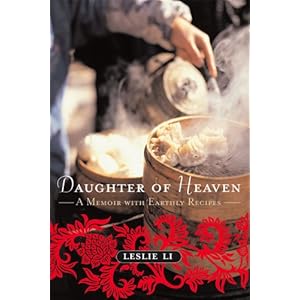
Have been reading Leslie Li's culinary memoir Daughter of Heaven: A Memoir With Earthly Recipes for the class I am teaching in Spring. Apart from the fact that her writing is absolutely fascinating, I am also wondering about a few things:

a. I am glad that I took up "food" (or should I say alimentation) as the theme of my class. My dissertation is primarily about violence, resilience and resistance. There is a heaviness to the things that come with it. On the other hand, food is essentially about survival, sustenance, creativity and celebration. At this point in my life, when everything is in the air, and I can hardly afford a decent meal, reading about food keeps me happy.

b. Food is about the quotidian. Consequently, there is an everyday-ness in the very writing of food memoirs that is hard to pull off in other genres. I am enjoying that everydayness immensely as I am working through Leslie Li.

By the way, Happy New Year!

Friday, December 30, 2011

::2012 Resolutions::


I have never accorded much importance to Resolutions or list-making. I am not a very organized person (euphemism for "scattered"), and lists and such have always seemed a little superfluous to me. I have always believed in going with the flow, to take things as they come, and take one day at a time. I still do. But as I am growing older, I am realizing, I don't have much time left. It's important for me to make the best use of the time I have, to be accountable to myself, to stay focused on things I want to achieve. Lists can be really helpful in that-- I can always log in to this page, and see for myself how much of my own stated goals I have achieved. So, here is my 2012 resolutions, with one caveat. I think, a year is TOO long a time. And the way my life is right now, I cannot really plan an entire year. So, here, I am trying to come up with a list of goals for the next six months of my life.

Academic

Finish my dissertation, defend and get my PhD. This can be achieved by writing and revising everyday. For that, I will also need to read articles, monographs and such everyday. Right now, I am working on my Introduction. I hope to get it done by the end of this break.

Font size
Teaching

I am teaching a class called "Food And Asian-American Popular Cultural Imagination" this Spring. I have the syllabus more or less planned. I am excited about the topic, and hope to do the best job I can. I am hoping to come up with some kind of a pedagogy article from my experience of teaching this class. So, I will try to keep extensive records of day-to-day teaching. I will also use this class as a springboard to conceptualize a conference paper, later to be developed into a journal article.

Writing

I have been working on my first collection of poems while working on my dissertation. A lot of these poems have come out individually in journals, some I am still sending out. Now, I need to make that leap-- collect, collate these poems into a coherent manuscript. I have begun that work during this break. By June 2012, I want to have a collection that is more solid, and send it out to two of my readers. Like the dissertation, for this too, I need to keep working on it everyday. I don't have any lofty goals for it yet, since my first priority is to get the dissertation done. But I want to stay with this project, keep thinking about it, revise the poems, tweak their orders, just so I am in touch. My aim here is progress, not perfection. The latter will come in the post-dissertation stage.

Reading

Three Bengali Novels: Keyapatar Nouko by Prafulla Roy, Epar Ganga Opar Ganga by Jyotirmoyee Debi, Meghe Dhaka Tara by Shaktipada Rajguru

Three English Novels: Pride and Prejudice by Jane Austen, Adventures of Huckleberry Finn by Mark Twain, The Circle of Reason by Amitav Ghosh

I am not making a list of poetry collections here. Since, in my experience, I do a better job of reading poems while working on the dissertation and regular pressures of teaching.

Food And Cooking

Learning six new recipes and blogging about them. Fall 2011 had been plain bad in terms of this. I was so tired that I failed to cook on most nights. Either I was fed by a friend (thanks, Ani) or, I would make some mush of rice, lentils and onions. I didn't even feel like making an one-pot stew. This needs to change. I do have a few recipes memorized which I can cook, improvise on etc. at the drop of a hat. But I would also like to get a little bit more adventurous in terms of my cooking skills.

Find A Job

Keep on applying...and ....er, finish the dissertation.

Developing A Consistent Offline Reflection Journal

I have tried this before, and have consistently failed. But as I am growing older, I feel this increasing need to write, reflect on things. But very few of these can be shared online. I recognize, so many of my reflections, memories, tidbits will be lost if I don't keep a regular log of these. So, I will try it one more time this year. Devote 10 mins. to it. Everyday.

Thursday, December 29, 2011

::{Me}::

The past year has been hard in many many ways-- emotionally, financially. But I have learnt a great many things too. Amongst them, my realization about my own work. I have always felt that my academic and creative work are inter-related. But on a regular day, when I am struggling between grading, conversing with crazy supervisors, multiple deadlines, unpaid bills-- I mean, all the travails of an overworked, underpaid graduate student-- it is very very easy to lose track of those lofty feelings. But then, this past year, while struggling to keep sane, I recognized certain things. As much as I struggle with the institutional work of academia, I Love engaging in knowledge production. Knowledge production itself is one of the most profound political acts, and when done in a mindful kind of a way, politicizes and empowers the producer. There are lots of ifs and buts and complexities within the folds of the sentence I just wrote, but this is something I have come to believe in strongly in the last few months. In the same way, the more I engage with creative writing, art-making, I become convinced, writing a poem too is an act of knowledge-producing. A poem acts differently than a piece of academic essay-- on a more affective plane. But then, isn't my dissertation bound to my life-quest? If I didn't necessarily grow up within the politicized, lefty sub-culture, would I have been interested in writing a dissertation on representation of women in slave rebellions? Isn't my dissertation an expression of my pre-occupation with the ways in which philosophies, discourses, imaginations of class-struggle interpellate women? It is. And that is hugely autobiographical in some very fundamental way.

Apparently, the academic work I do, has nothing to do with me per se. I am not working on Bengali women's writing. I am not working on Bengali or even South Asian literatures. Although there is a strong South Asian component in my work. Yes, in amy academic work I branch out. I explore who I am not. What history is not mine. While in my poems, especially in this collection, in my insistent writing of the private-space, of domesticity, a very specific form of post-Partition, post-Naxalbari Bengali domesticity, it is all about figuring out who I am. Writing in, so to say. But then, isn't my dissertation also about figuring out who I am through an exploration of who I am not? The am exists in the guise of not. Besides, aren't the histories of slave rebellions also mine? Who will determine what history is mine and what is not mine? Is there only one way of laying claim to a history? Through a lens of ethnic-national-racial "authenticity"? I don't think so.

So, right now, I want to stop for a minute, and celebrate the fact that I can both move in and walk out. It's a rare privilege to be able to do so. And I AM privileged.